

Published on April 21 2026 In Scientific news Research
Due to a lack of ice, Arctic cod are moving north
An article by Valérie Levée, science journalist
During her eight-year tenure at the Greenland Institute of Natural Resources in Nuuk, Professor Caroline Bouchard studied the population dynamics of Arctic cod. As noted in her study published in February 2026 in Arctic Science, the evidence points to one conclusion: the waters off southern Greenland are no longer suitable for the fish, and it is migrating northward.
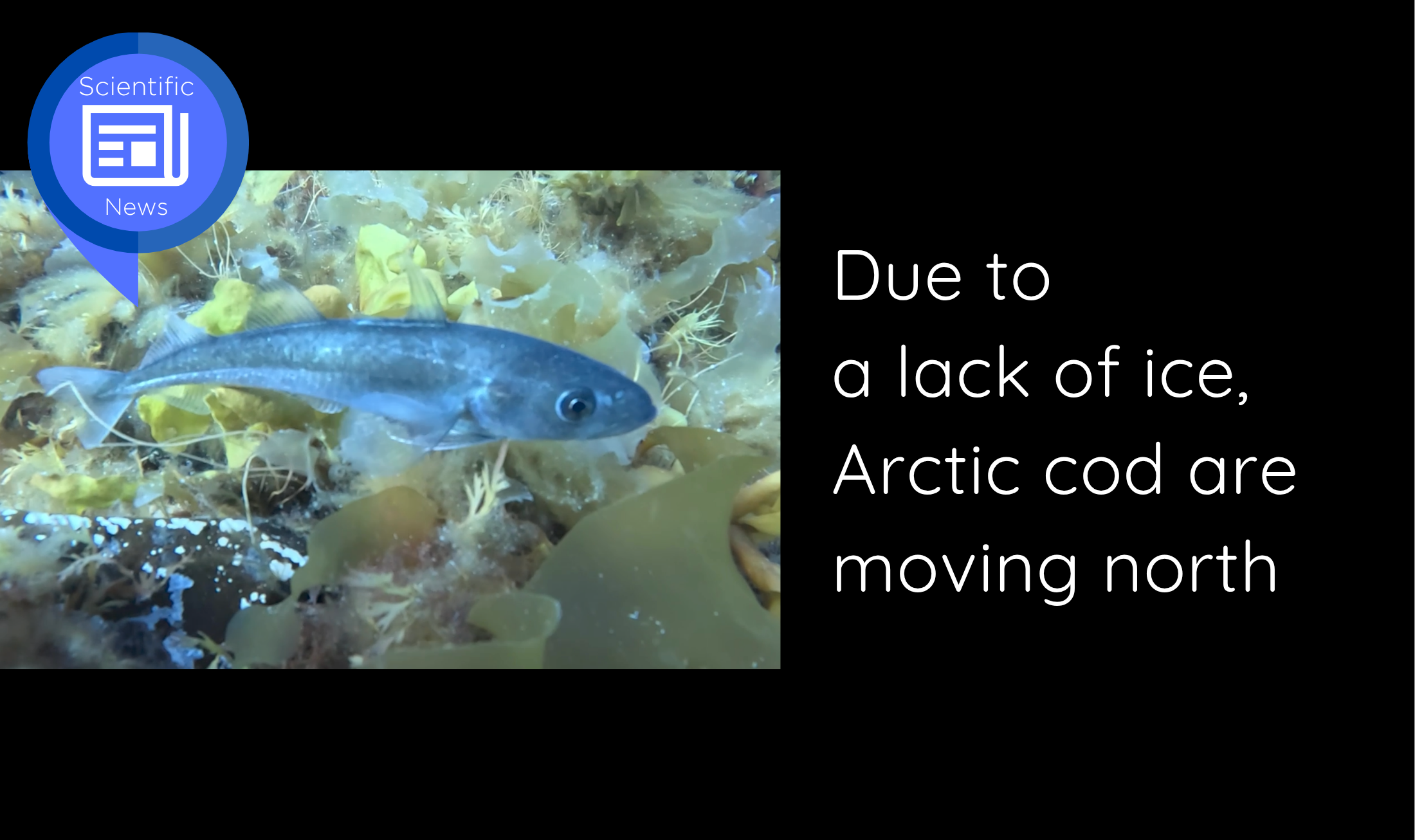
A close relative of the Atlantic cod, the Arctic cod is a key species for the ecosystem and for Greenlandic culture. It measures 15 to 30 cm and is one of those small pelagic fish that play a central role in the food web. It feeds on crustaceans such as copepods and serves as prey for marine mammals and seabirds. As for the Greenlanders, they fish for Arctic cod not to eat it, but to use it as bait for halibut fishing. Despite the importance of this small fish, no specific studies had been conducted on it when Caroline Bouchard arrived at the Greenland Institute of Natural Resources.
Still, the Institute did have data on the presence of cod in Greenlandic waters.
“There is a lot of fishing in Greenland, and the institute conducts fishing surveys to document the status of the populations of the species being fished. Arctic cod is not fished for consumption and is not specifically targeted in these surveys, but it is a bycatch that is still counted,” explains Caroline Bouchard.
These surveys, which have been conducted since 1993 and cover the east and west coasts of Greenland, provided a high-quality temporal and spatial dataset for modeling Arctic cod populations and tracking their trends over the years. The results are unequivocal: the cod has shifted northward. Interviews with Greenlandic fishermen in the Ammassalik region of southeastern Greenland confirmed that cod, once abundant, had virtually disappeared from their area.
Toward the borealization of Arctic ecosystems
Greenlandic hunters have provided another clue: in Disko Bay, ringed seal hunting is on the decline, whereas it is thriving in Upernavik, located further north. Since ringed seals feed on Arctic cod, it is not surprising that they follow them. But cod also follow their prey—namely, Calanus glacialis and Calanus hyperboreus, two species of copepods rich in lipids.
“The Arctic food web is based on lipids. If these Calanus are absent, there’s little chance of finding cod because they don’t have access to high-quality food,” explains Caroline Bouchard.
However, samples collected in the waters of Disko Bay from 1992 to 2018 show that Arctic Calanus populations are declining, which is consistent with a decrease in cod catches in the same region.
More generally, these observations are part of what scientists call borealization, or the transformation of Arctic ecosystems into boreal ecosystems. Biological communities are changing with the arrival of new species from the south or with shifts in the relative abundance of species. “In Disko Bay, alongside our Calanus glacialis and hyperboreus, there is also an Atlantic species, Calanus finmarchicus, but now there are many more of them,” explains Caroline Bouchard.
Too warm in the south for cod
The Arctic cod lives up to its name: it thrives in cold water and ice, especially the eggs and larvae, which cannot move and are dependent on environmental conditions. Highly sensitive to changes in water temperature, the eggs do not survive at temperatures above 3 °C, nor do the larvae when the temperature exceeds 5 °C. Juveniles and adults are more tolerant and, crucially, can move around. Eggs are laid in winter and require ice cover, particularly to protect them from UV rays.
Unsurprisingly, climate change is working against them. The research team used satellite data to track ice cover and the date of ice break-up since 1993, focusing on the first three months of the year, which correspond to the early stages of cod development. It appears that even in winter, in the Disko region, the ice cover is disappearing. By the time spawning occurs, the eggs no longer have the protection of the ice cover.
“This is another piece of the puzzle, and when you put all the data together, you can really see that between 1993 and 2015, the indices dropped dramatically, coinciding with the decline in the Arctic cod population all around Greenland,” concludes Caroline Bouchard.
Recommendations
- Between Canada and Greenland, Arctic cod inhabit the same waters, which are divided by a political border, but ecosystems know no borders. Greater collaboration between these countries and better integration of local and Indigenous knowledge into marine science would help to better protect Arctic biodiversity and Inuit biocultural heritage.
- The study also shows that the northern shrimp fishery may have contributed to the historic decline of Arctic cod. In fact, the vast majority (93%) of Arctic cod found in Greenlandic fishing zones are vulnerable to shrimp nets. The authors therefore recommend closer monitoring of Arctic cod bycatch in this growing fishery.
For more information:
- Jansen, T., Post, S., Becker Jacobsen, R., Werner, K. M., Friis Møller, E., Rosing-Asvid, A., Burmeister, A., Burdenski, A., Qatsa, M., and Bouchard, C. (2026). Decline and northward shift in Arctic cod distribution associated with the changing climate around Greenland. Arctic Science, 12: 1-36. https://doi.org/10.1139/as-2025-0028
- Bouchard C., Charbogne, A., Baumgartner, F., and Maes, A. M. (2021). West Greenland ichthyoplankton and how melting glaciers could allow Arctic cod larvae to survive extreme summer temperatures. Arctic Science, 7(1), 217-239. https://doi.org/10.1139/as-2020-0019
- Bouchard, C., Farnole, P., Lynge-Pedersen, K., Dahl, P.E., and Christiansen, H. (2023). Arctic cod (Boreogadus saida) in fjord and glacial habitats: a collaborative study with Uummannap Kangerlua fishers. Arctic Science, 9(4), 781–795. https://doi.org/10.1139/as-2023-0014
- Geoffroy, M., Bouchard, C., Flores, H., Robert, D., Gjøsæter, H., Hoover, C.,… Walkusz. W. (2023). The circumpolar impacts of climate change and anthropogenic stressors on Arctic cod (Boreogadus saida) and its ecosystem. Elementa: Science of the Anthropocene, 11(1), 00097. https://doi.org/10.1525/elementa.2022.00097
_____
Researcher Caroline Bouchard's affiliations:
- Institut nordique du Québec
- ArcticNet
- Takuvik
- Québec-Océan
- Greenland Climate Research Centre
_____
Photo credit: Camille Lavoie
Back to news