
In Nunavik, the thawing of permafrost is destabilizing buildings, leading to potential structural damage and water infiltration into the building envelope. This raises the question of how to detect water damage in walls before it is too late. Cindy Dumais is a doctoral student in Professor Caroline Duchaine's lab at the Institut Universitaire de Cardiologie et de Pneumologie de Québec at Université Laval, and she has found the answer in fungi.
News
The SIKU platform supports Indigenous knowledge and data sovereignty. Watch the demonstration led by Candice Sudlovenick from the Arctic Eider Society.
The Scientific Council of UArctic has appointed Professor Daniel Chartier as the UArctic Chair on Images, Perceptions and Mediations of the Arctic for a term ending December 31, 2029.
Its round shape and central island have earned Lake Manicouagan the nickname 'the Eye of Quebec'. This unique lake is located within a meteorite crater and is the deepest in Quebec, reaching depths below sea level. The lake is also part of the territory of the Innu people, which was lost in 1970 when the Manic-5 dam was commissioned. Léo Chassiot, a professor in the Department of Environmental Sciences at the Université du Québec à Trois-Rivières, has made it his mission to decipher the history of this now-submerged landscape, which is preserved in the lake's sediments.
Applications are now open for the UArctic north2north mobility program, which offers the opportunity to study in different regions of the North.
A north2north exchange allows you to acquire skills in Arctic-related fields and discover another North, which will be useful in your future professional career and academic projects.
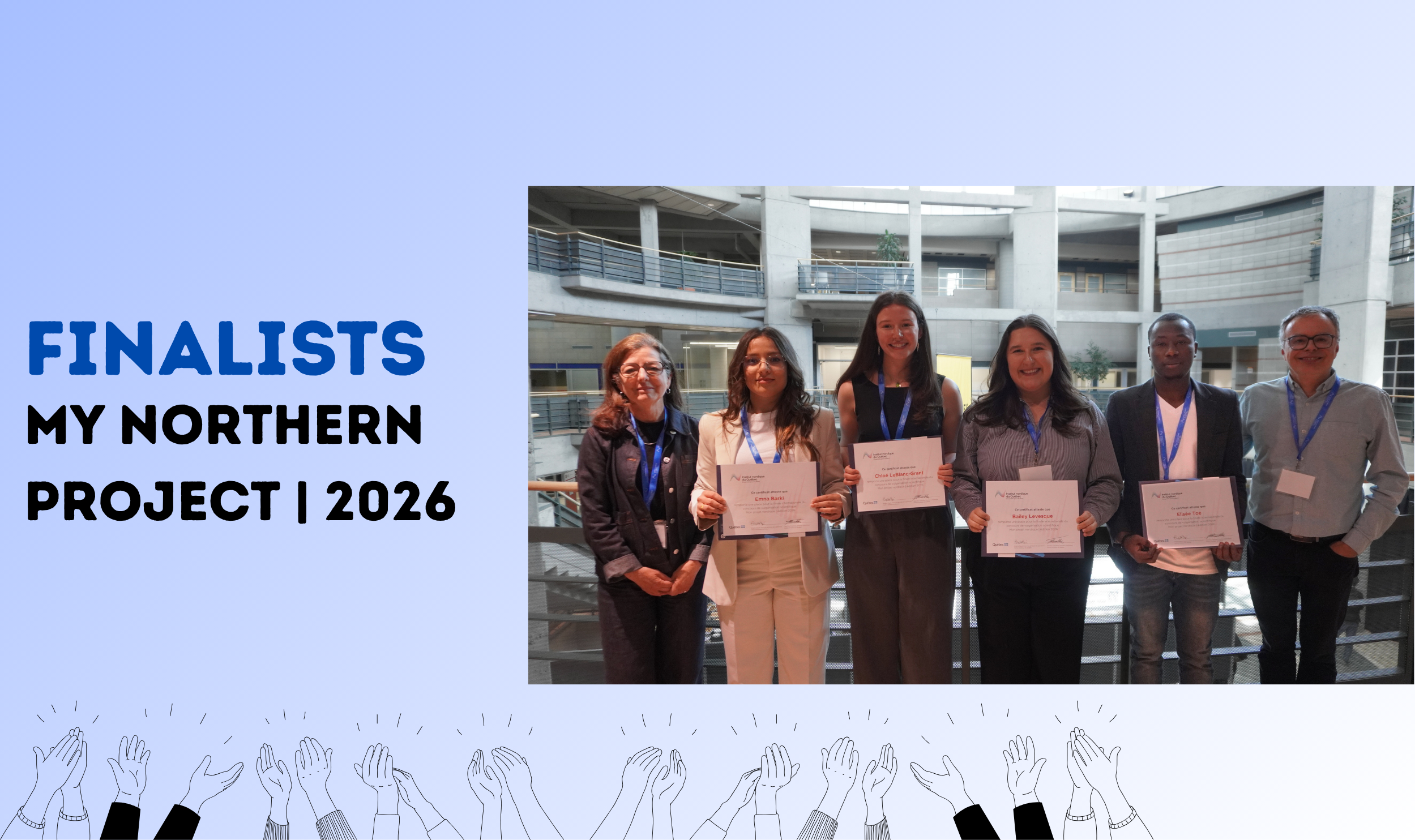
INQ invites master’s and doctoral students working on a northern or Arctic-related topic to submit their application to take part in the provincial final of the science communication competition My Northern Project (MNP).
Registration is now closed.
The course will run from January 30 to April 24, 2026, and will include 12 sessions.
Check out the December 2025 newsletter!
The INQ team would also like to wish you a joyful holiday season.
Take time to rest, have fun, and come back refreshed in 2026 for exciting new projects!
Since its launch in 2017, nearly 15,000 people have taken the MOOC “Northern Quebec: Issues, Spaces, and Cultures,” a free online course that explores the realities of northern Quebec. Good news: it's coming back in February 2026! (French version)
(All places have been filled.) On January 30, 2026, Institut nordique du Québec invites you to participate in an online training and awareness workshop entitled Myths and Prejudices Against Indigenous Peoples. This activity will be conducted in French.
Check out the INQ newsletter for the latest news. This newsletter was published on November 28, 2025. Consider subscribing if you would like to receive it directly in your inbox.
Two researchers affiliated with INQ, Michelle Garneau (UdeM) and Mélanie Lemire (ULaval), are among this year's Acfas award winners. Professor Marianne Falardeau (TÉLUQ) is one of five scientists to watch in 2025 worldwide, according to Science News Magazine. The INQ extends its sincere congratulations to these three inspiring individuals.