

Published on June 26 2026 In Training Research
Knowledge Transfer and Mobilisation in the Village of Kangiqsualujjuaq
An interview conducted by Rachel Hussherr, training committee coordinator and UQ Pole regional coordinator at INQ.
Two students who participated in INQ's "Introduction to research and northern issues" (IREN) training spent a week in the Northern Village of Kangiqsualujjuaq at the end of April to share their research results with the community. Their respective projects, developed during their master's degrees at UQAT for one and UQAR for the other, addressed topics of interest for this Nunavik community located on the shore of Ungava Bay.
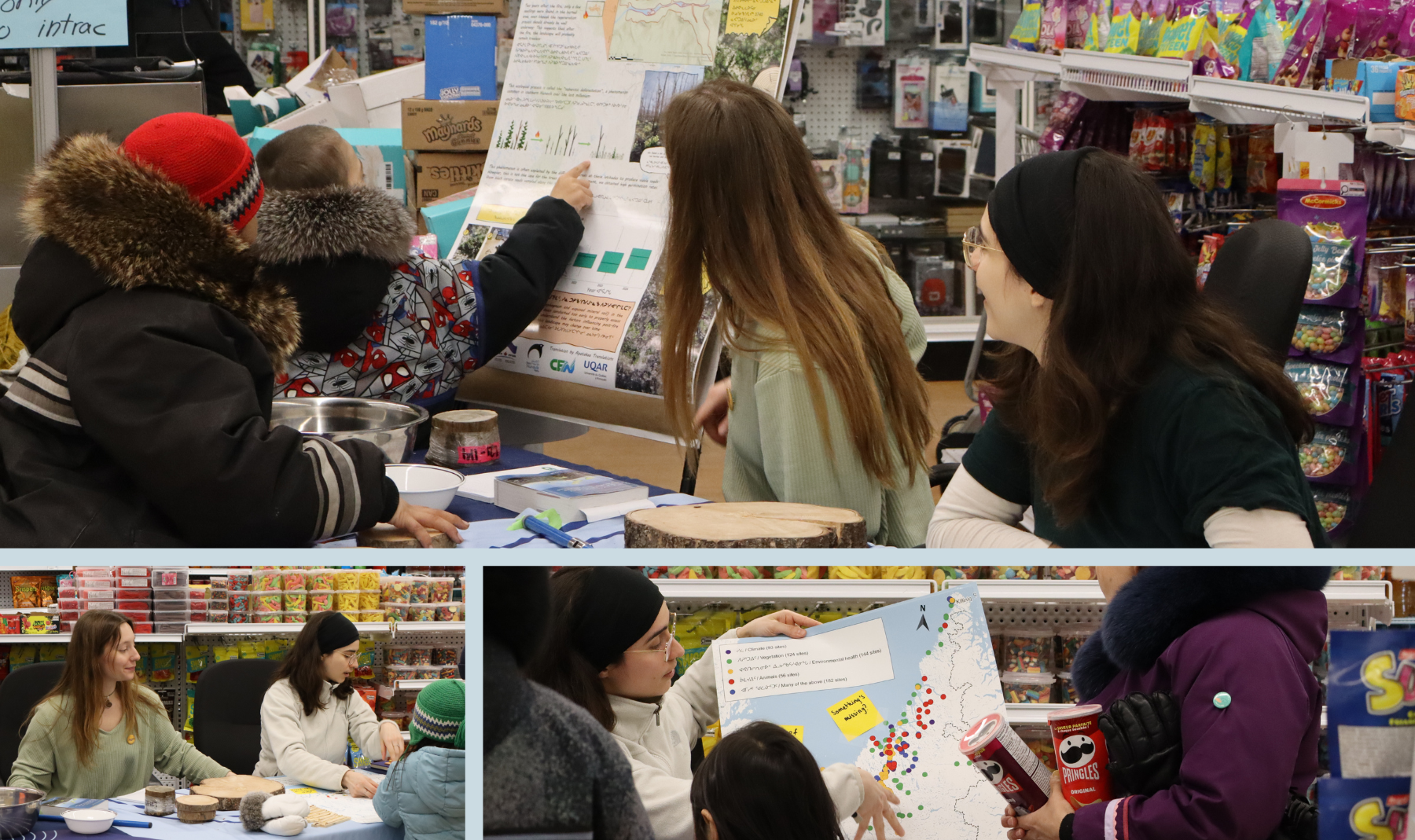
Through various activities, they were able to communicate relevant results in attractive and accessible formats for community members. For example, the two students went to the elementary school to offer educational workshops related to their work. They also shared their knowledge in greater detail with local project partners during meetings in the village. Finally, they set up a booth at the village COOP for an afternoon to meet and engage with local residents.
A look back at their trip and what the IREN training brought them.
QPlease introduce yourselves
RQ : I am Raphaëlle Quiriault, a master's student at UQAT in Indigenous studies, and I am affiliated with CIÉRA.
BD : I am Béatrice Dupuis, and I am a master's student in forest ecology at UQAR.
Q If you had to summarize your project in just one or two sentences?
RQ : My research project is a systematic mapping (a form of literature review) that aims to identify all environmental monitoring initiatives conducted near the northern village of Kangiqsualujjuaq. I searched for documents produced between 1900 and 2023.
BD : I work on post-fire regeneration at the northern and southern limits of the forest tundra [in Nunavik]. The starting point of the project was an exceptional fire event in the Kuururjuaq River valley, and people from the community expressed a desire to have an assessment of this fire's impact. Their concerns also included water quality and fish, but I focused on the vegetation aspect. The perspective of the project was to understand the active ecological processes in the forest tundra (which fits into landscape dynamics).
QIf you had to share only one or two key findings?
RQ : I found 122 documents related to some of the themes addressed by the Imalirijiit program. In this inventory, most documents accessible on the web come from academics (around 80). The analyzed documents show that there was a peak in data collection starting in 1980, which suggests that more people came to this region to conduct environmental studies.
BD : Following the fires, it seems that the forest is having difficulty regenerating. This is the subarctic deforestation process, which has been active for a very long time and is well documented. However, the traditional explanation was that a climate too cold prevented regeneration. Except that knowing we are now in an era of climate warming, and therefore temperature is less and less of a limiting factor, it seems this process is still active despite the warming. So the process may be less simple than previously assumed, or else there is an ecosystem response delay to warming.
QHow did the desire to add a "knowledge sharing" component to your master's project come about?
RQ : I anchored my research in a data restitution approach. I am in a social sciences department, so this was also highly appropriate. Working on the issue of returning data to communities, I obviously had to practice what I preached to address the problem I described. I truly conducted my research from a posture where I told myself I would try to equip the community, within what is realistic for a master's degree. With this in mind, I had to return to them. I made 3 trips to the village: the first to get the community's approval for the project, the second trip was an initial return of results, and my third trip is more about knowledge mobilization: How can we ensure that the results are disseminated locally ?
BD : My research question arose from the concerns expressed by the village residents here. Sharing the results was therefore obvious to answer this question at least partially. It is a pleasure for me to help make data accessible to those who are affected. I also wanted to produce alternative educational material to a scientific article, precisely to make it accessible.
RQ : It's true that we are sharing results, but we are also adapting our content. We are fully engaged in this feedback process.
QYou both participated in an edition of INQ's "Introduction to Northern Research and Issues" training, Raphaëlle in 2023 and Béatrice in 2025. How did your approach to your project change after that?
RQ : During the training, I reflected a lot, questioned myself, and at times felt challenged. Before the training, I was anxious because I wondered if I was doing the right thing working on such a topic in an Inuit context as a non-Indigenous person. After the training, it gave me the breakthrough to overcome that.
BD : I signed up for the training knowing that I would return to the community to share the knowledge. I wanted that moment to truly be a time for exchange, and for it to be grounded in an ethical posture, to ensure the transmission of results in an accessible, respectful, and mutually beneficial way. I liked that the training brought together speakers from several disciplines and different organizations. I find that sometimes, when we stay confined to our specialty, new information can trickle in slowly. Here, I was exposed to completely different disciplines, for example, professors Thierry Rodon and Cynthia Morinville who gave workshops on the Northern economy. It was a massive influx of information because I was starting from scratch on that subject. It also allowed me to meet many wonderful people.
RQ : Yes, it's true that the networking that comes with it is significant too.
BD : Students, researchers, professionals... I really appreciated that the edition I participated in was held at Camp Kanapeut. It was truly enriching.
QWould you like to share a memorable moment from your week in the village during your mobilization activities?
BD : One of my highlights was during the meeting with the partners, when I saw the curiosity my presentation generated. I found that really motivating. It shows that my work matters and is relevant.
RQ : In the classroom, I was touched to see the children take ownership of the tools I was presenting to them. I had an online map and showed them how to navigate it with the mouse to look for places they knew.
INQ warmly congratulates Raphaëlle Quiriault and Béatrice Dupuis for their commitment to the community and partners of Kangiqsualujjuaq. Their approach brilliantly embodies the values of the "Introduction to research and northern issues" (IREN) training.
Back to news