

Published on August 6 2026 In INQ Community Research
CASCADES Expedition sets sail to investigate the impacts of Greenland glacier melt on the Arctic and beyond
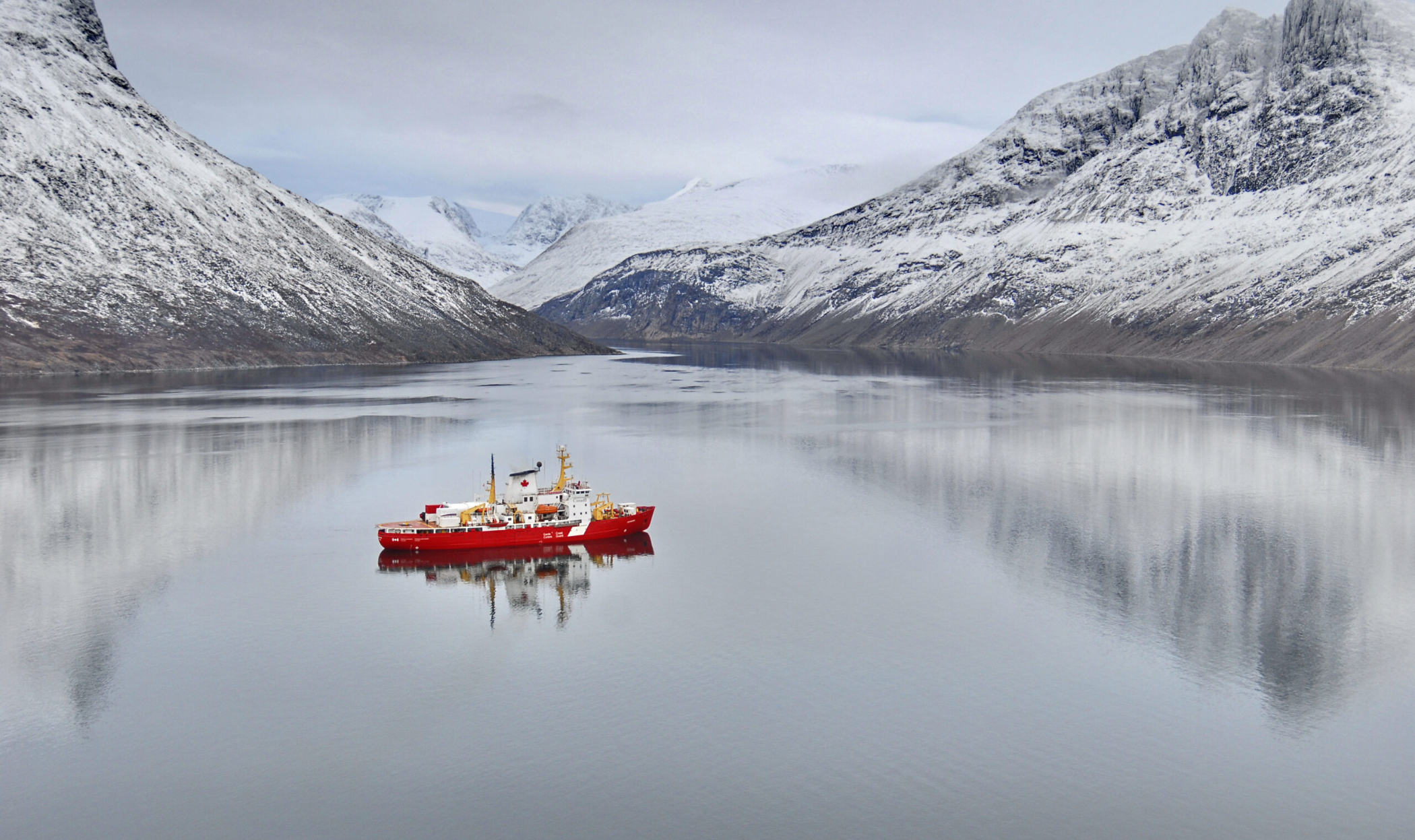
Sion / Brest / Québec City, 6 August 2026 – Today, the CASCADES Expedition leaves Québec City aboard the Canadian research icebreaker CCGS Amundsen for its first leg in Baffin Bay and along the west coast of Greenland. The international expedition federates over 50 researchers from Canada, France, Greenland, and Switzerland across 13 multidisciplinary projects that will generate critical observations from one of the world’s fastest-changing regions, helping improve projections of future climate change while strengthening international scientific collaboration. Coordinated by the Institut nordique du Québec (INQ), the Swiss Polar Institute (SPI) and the French Polar Institute (IPEV), the CASCADES Expedition benefits from the scientific infrastructure provided by Amundsen Science and is an endorsed action of the United Nations Decade of Ocean Science for Sustainable Development.
The CASCADES Expedition will explore how melting glaciers, sea ice, and ocean ecosystems interact and shape the environment and the communities in the Arctic. This research is essential as the Arctic region is critical to climate systems worldwide. Switzerland is warming at about twice the global average, making international polar research increasingly relevant to local climate challenges that lie ahead.
Bringing together 13 international scientific projects covering 7 research clusters – spanning glaciology, oceanography, biogeochemistry, marine ecology, atmospheric science and climate modelling – and involving around 20 research institutions from four different countries, the expedition highlights the importance of international cooperation and the involvement of local communities when it comes to studying the changing climate and its impacts. The expedition is an endorsed action of the United Nations Decade of Ocean Science for Sustainable Development and contributes to the United Nations Decade of Action for Cryospheric Sciences.
The CASCADES Expedition will take place in two legs, aligned with two key Arctic phases: the melt of sea ice in August and the freeze-up in November. The first leg (Leg A) will conduct sampling along oceanographic transects in Baffin Bay and across a latitudinal range of glacier-fjord systems along the west coast of Greenland, with potential for land deployments. The second leg (Leg B) will focus on sea-ice formation in western Baffin. Studying these dynamics will bring a better understanding of ongoing climate shifts in the Arctic that affect the entire world.
Alongside the expedition, SPI is launching CLASSCADES, a series of free learning modules in French and German that will enable schoolchildren aged 8 to 12 to follow the expedition from their classrooms, to explore the science and daily life aboard the icebreaker CCGS Amundsen, and to learn about the Arctic and its importance. Starting in September, CLASSCADES is designed by Swiss Polar Class, the educational programme developed by SPI for primary schools.
"The CASCADES expedition is an unprecedented effort to better understand the transformation of Greenland's glaciers and the impact of their melting on the ocean and coastal communities. The global scale of this major challenge explains why researchers from several countries are coming together and pooling their expertise to analyze the many facets of this change—from glacier dynamics to the response of the marine ecosystem, which underpins biological productivity and moderates the climate. Beyond the numerous measurements that will be taken, CASCADES is a fine example of scientific diplomacy and international collaboration.” – Jean-Éric Tremblay, Co-Chief Scientist of the CASCADES Expedition, Scientific Director, Institut nordique du Québec
“CASCADES enables ambitious Swiss research projects and fosters cutting-edge international cooperation. As the Swiss Polar Institute celebrates its tenth anniversary this year, we are proud to support this collaboration between Canada, Switzerland, France and Greenland. The knowledge generated during this expedition in the Arctic will also help us better understand and address the environmental changes that are happening closer to home.” – Christoph Hegg, Chair, SPI Foundation Board
“The oceans preserve the memory of past climate changes and help us better understand those of today. By combining field observations and scientific analyses, this expedition will gather essential data to decipher the interactions between the ocean, ice, and climate, and to better assess possible trajectories.” – Prof. Samuel Jaccard, University of Lausanne, Co-chief Scientist of the CASCADES Expedition
MORE INFORMATION
→ CASCADES Expedition website in English
→ CASCADES Expedition official Instagram account
Picture: © Keith Levesque, ArcticNet, Amundsen Science
Back to news