

Published on March 9 2026 In Scientific news
Will permafrost thaw cause fungi to flourish?
An article by Valérie Levée, science journalist
In Nunavik, the thawing of permafrost is destabilizing buildings, leading to potential structural damage and water infiltration into the building envelope. This raises the question of how to detect water damage in walls before it is too late. Cindy Dumais is a doctoral student in Professor Caroline Duchaine's lab at the Institut Universitaire de Cardiologie et de Pneumologie de Québec at Université Laval, and she has found the answer in fungi.
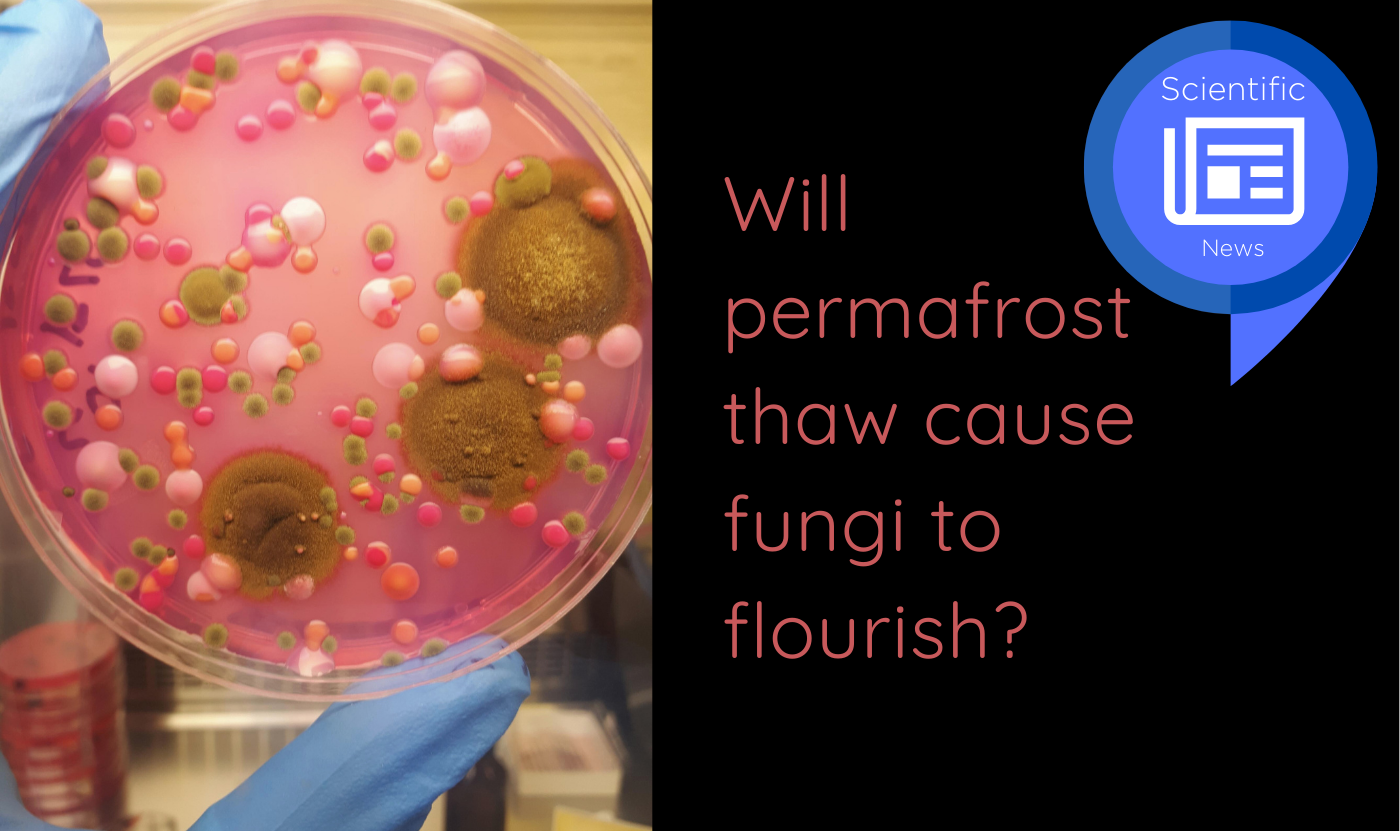
Fungi thrive in moist environments and quickly colonise areas where moisture persists. Certain mould species, such as Stachybotrys chartarum, Chaetomium globosum and Trichoderma viride, grow on building materials and are indicators of water damage to structures. Consequently, Cindy Dumais searched for fungi in homes in Nunavik. As well as looking for species that indicate water damage, she searched for species of the genera Aspergillus and Penicillium, which are often found indoors, and Cladosporium, which is present in outdoor air.
She sampled the air circulating in homes. “We use a leaf blower to blow dust around a room for a few minutes to mix everything up. Then, we use a pump to sample the air and collect it on a filter,” she explains. This technique dislodges mould living hidden in walls, and Cindy Dumais points out that the mould sampled in the circulating air includes all the mould present in a room. However, the study does not permit conclusions to be drawn about people's exposure to potentially harmful mould. If mould was visible on surfaces, Cindy Dumais also sampled it to see if there was a link between the species present in the air and on surfaces.
To see if outdoor mould was being carried indoors, Cindy sampled the air and surfaces in different rooms of 60 houses in both summer and winter, as well as taking an outdoor air sample. Back in the laboratory, she extracted DNA from the samples to detect and quantify the presence of the species of interest.
Visual inspection is not enough
The analyses revealed no significant differences between rooms in different houses, probably because the leaf blower technique mixes and homogenises the air. Instead, the surprise was to see a seasonal difference, with more mould in summer than in winter.
"We thought the air would be more confined in winter, resulting in more mould. However, we noticed that the ventilation system is activated at the same time as the heating system, and we think this dilutes the air during the winter. During summer, there is no need to heat homes or use ventilation," Cindy Dumais explains.
On the one hand, opening windows occasionally allows Cladosporium to enter; however, this is not enough to remove Aspergillus and Penicillium species present indoors or those that indicate water damage. In winter, even if ventilation reduces concentrations, these species are still present.
The situation is reversed for mould collected from surfaces. The quantities do not vary with season, but differences are observed between rooms. Furthermore, samples taken from surfaces do not always contain species found in the air, such as those indicating water damage. "They are probably in the ceilings and walls since we were able to detect them using the leaf blower-circulating air technique. Without this method, we would not have found them. So it's important not to rely solely on visual inspections,” comments Cindy Dumais..
In this initial analysis, Cindy Dumais focused on key species, but she has already started expanding her analysis to describe the diversity of fungi present in homes in Nunavik. She also intends to revisit the sites to collect further samples using a less invasive technique, potentially by utilising ventilation system filters.
Recommandations
- Try to use the simplest possible sampling method.
- Popularise science and the project among community members so that they feel involved and included in the development and implementation of the project.
Affiliations
- Centre de recherche de l'Institut universitaire de cardiologie et de pneumologie de Québec, Université Laval.
- UK Centre for Moisture in Buildings, University College London
- Institut nordique du Québec
To learn more
Dumais C., Veillette, M., Efthymiopoulos, S., Bissonnette, E., Daignault, L. Dubé, M., Hunt, S., Ouazia, B., Ioannou, I., Yang, W., Aktas, Y.D., & Duchaine C. (2026). Assessing fungal burden in Nunavik homes across seasonal conditions: Relationship between air and surface contamination. Building and Environment, 289, 114111
https://doi.org/10.1016/j.buildenv.2025.114111
Aktas, Y.D., Duchaine, C., Efthymiopoulos, S., Miron, P., Ouazia, B., Veillette, M., Watt, L., Yang, W., Ahmad Khan, F. (2023). Housing-related determinants of lung health in Nunavik, Canada.
Dans : Proceedings of the 2nd International Conference on Moisture in Buildings 2023 (ICMB23). ScienceOpen: Online
https://doi.org/10.14293/icmb230049
Back to news