

Published on March 12 2026 In International Research
INQ participation in the World Ocean Summit
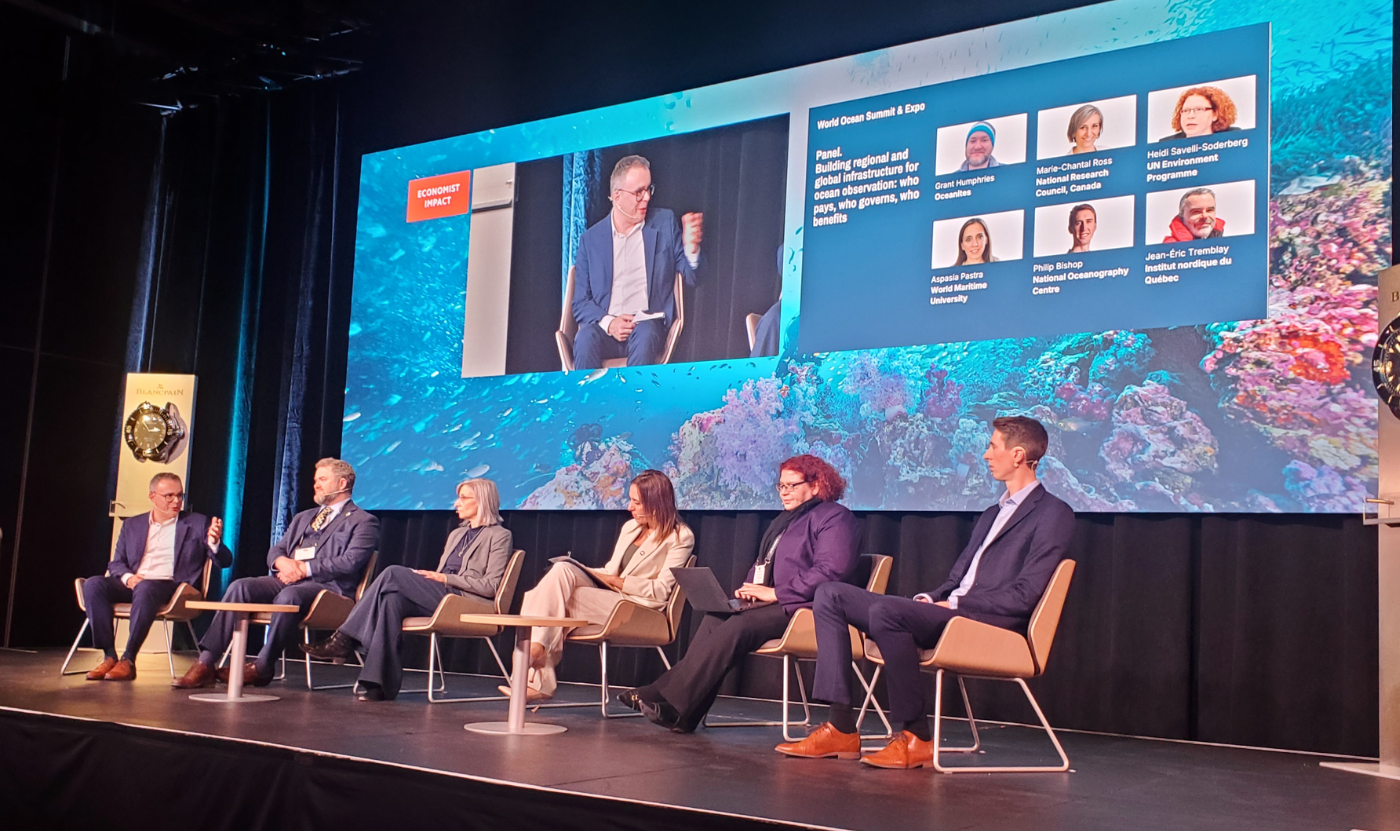
On March 4, Jean-Éric Tremblay, Scientific Director of Institut nordique du Québec (INQ), played a key role at the 13th annual World Ocean Summit held in Montreal. This world-renowned event, organized by Economist Impact, brings together policy makers, investors, scientists, and Indigenous leaders. The goal is to move from major international agreements to concrete actions to protect and sustainably exploit our oceans.
A crucial panel on ocean observation infrastructure
Jean-Éric Tremblay moderated a strategic discussion entitled: “Building regional and global infrastructure for ocean observation: who pays, who governs, who benefits?” The panel addressed the urgent need to move from fragmented ocean observation to a shared and interoperable global infrastructure. Discussions focused on:
- International collaboration
- Funding and governance
- Equitable benefits
High-level experts
To explore these issues, Mr. Tremblay was joined by a panel of international experts:
- Grant Humphries, director, science, Oceanites
- Marie-Chantal Ross, program director, ocean, National Research Council, Canada
- Heidi Savelli-Soderberg, programme officer, marine litter and plastic pollution, UN Environment Programme
- Aspasia Pastra, assistant professor, Sasakawa Global Ocean Institute, World Maritime University
- Philip Bishop, head, commercial development, National Oceanography Centre
This participation underscores INQ's commitment to building bridges between scientific research and global governance for the sustainability of our oceans.
Panel summary
No single country can track the health of the ocean alone, yet today ocean observation is fragmented. European satellites don’t always talk to Asian sensor networks, and Arctic data may never reach researchers in the tropics. What would it take to stitch these efforts together into interoperable, shared infrastructure? Should financing come from governments, philanthropies or industry, and who sets the rules for access and use? And while science gains from better data, how do we ensure that fishermen, coastal planners and vulnerable communities see the benefits too?
Photo by Guillaume St-Onge
Back to news