

Published on February 13 2026 In Research
Creation of a UArctic Chair on Images, Perceptions and Mediations of the Arctic
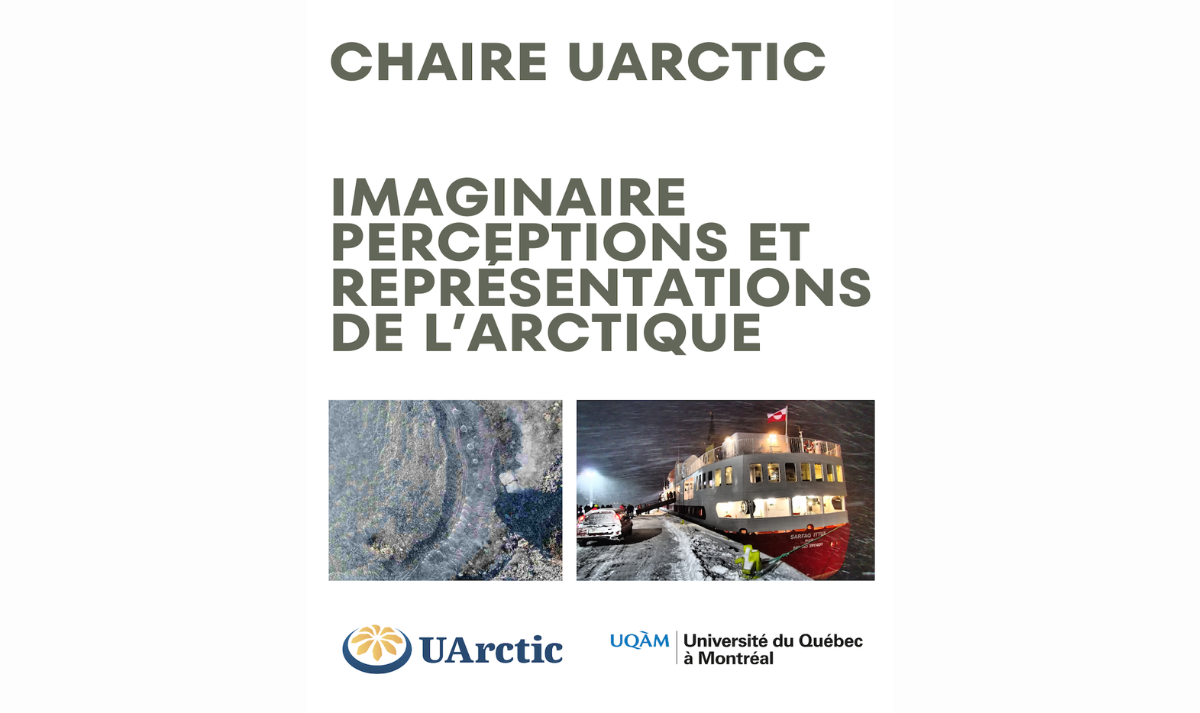
The UArctic Scientific Council has appointed Professor Daniel Chartier as the UArctic Chair on Images, Perceptions and Mediations of the Arctic for a term ending December 31, 2029.
UArctic in the Circumpolar Context
UArctic (University of the Arctic) was officially founded in 2001, following a decision made in the 1990s by the Arctic Council as an extension of the Sustainable Development Working Group (SDWG). Its creation was part of the practical implementation of the Arctic Environmental Protection Strategy (AEPS, 1991) and the formal structuring of the Arctic Council in 1996. The objective was to provide the circumpolar region with a permanent academic infrastructure capable of strengthening education, research, and training for Northern populations, particularly within Indigenous communities.
Today, UArctic brings together more than 200 member institutions (universities, colleges, research institutes, and Indigenous organizations) across the eight Arctic states and beyond.
It maintains institutional and programmatic ties with UNESCO, notably in the fields of education for sustainable development, open science, the preservation of intangible cultural heritage, and the recognition of Indigenous knowledge as legitimate expertise. UArctic regularly collaborates within UNESCO’s normative frameworks (including the 2003 Convention for the Safeguarding of the Intangible Cultural Heritage and programs related to the Decade of Indigenous Languages), thereby integrating Arctic issues into major international policies regarding science, culture, and education.
UArctic Chairs
UArctic Chairs are among the most prestigious distinctions in the field of Arctic studies globally. They are awarded to a limited number of researchers recognized for their excellence, scientific leadership, and ability to establish long-term circumpolar research networks. Their appointment is based on an international evaluation and the recognition of a major scientific contribution to Arctic knowledge across theoretical, methodological, and societal dimensions.
These chairs grant their holders benchmark status in their field, placing them at the heart of major circumpolar scientific cooperation dynamics. They play a strategic role in guiding research priorities, training the next generation of international scholars, and fostering dialogue between science, public policy, and Indigenous communities. To hold a UArctic Chair is to be recognized as an international authority in one’s field, capable of bridging cutting-edge research, science diplomacy, and the global circulation of knowledge about the Arctic.
The UArctic Chair on Images, Perceptions and Mediations of the Arctic
The UArctic Scientific Council, upon the recommendation of the Rector of the Université du Québec à Montréal, Stéphane Pallage, has appointed Professor Daniel Chartier as the UArctic Chair on Images, Perceptions and Mediations of the Arctic for a term ending December 31, 2029. Daniel Chartier is recognized as a world-class researcher in the field of cultural and social representations of the North, winter, and the Arctic. Since 2001, he has participated in numerous cooperation projects with Indigenous organizations and Northern and Arctic research bodies, both in Canada and abroad. His work follows a multicultural and circumpolar perspective in collaboration with communities, which involves respecting and defending Arctic multilingualism and building bridges between the North and the rest of the world.
The UArctic Chair on Images, Perceptions and Mediations of the Arctic aims to study, through a comparative, multilingual, interdisciplinary, and collaborative approach, the various cultural and social representations of and about the Arctic. The chair relies on the infrastructure of the International Laboratory for Research on Images of the North, Winter and the Arctic, founded in 2003 by Professor Chartier. This laboratory serves as an infrastructure for research, dissemination, publication, expertise, and cooperation to establish contacts between all Arctic cultures (with past and ongoing funded research projects involving Canada, Sweden, Denmark, Norway, Finland, the Faroe Islands, Iceland, and Greenland), as well as with Arctic communities and Indigenous organizations (Inuit, Innu, Greenlandic, Atikamekw, and Sámi).
nord.uqam.ca
Note: This is a courtesy translation. In case of discrepancy, the original French version shall prevail.
Back to news